02/12/26
Best of the West: Using AI to map groundwater; Nevada attainable housing; Data cloud in space; SD boosts EMS; Genetic resistance to chronic wasting disease; and an Olympic medal count
.png)
The Western Governors' Association keeps you updated on the latest news in the West. Here are the top stories for the week starting February 9, 2026. (Photos courtesy of Princeton University, NASA Jet Propulsion Laboratory, and the Office of South Dakota Governor Larry Rhoden).
In the West, groundwater supplies are essential to sustaining nearly every aspect of life, from agriculture and irrigation to drinking water and household use. As a result, some of the country’s best researchers – from Stanford to NASA – have poured resources into accurately measuring groundwater resources.
Last month, researchers from the University of Arizona and Princeton University unveiled the most detailed groundwater mapping tool yet, using artificial intelligence and environmental data. Their map combines direct measurements and environmental data with AI to estimate groundwater levels across the continental US at a resolution of less than 100 feet.
The new map estimates a total of 306,000 cubic kilometers of groundwater in the US, or 13 times the volume of the Great Lakes. It also revealed supplies of shallow groundwater that were previously unknown.
In addition to this new tool, other researchers across the country have been employing innovative ways to measure this crucial resource.
For example, NASA’s Gravity Recovery and Climate Experiment (GRACE) satellite has been tracking Earth’s water movement since it was launched in 2002. A follow-up mission is currently in orbit, continuing to track water supplies by identifying minute fluctuations in gravitational pull to identify changes in water levels. Because aquifers and groundwater deposits have mass changes in their size and depth, it translates to small, measurable changes in the gravitational pull experienced by the satellites. A new NASA satellite aims to provide even more detailed measurements using a device no larger than a suitcase when it launches later this decade.
Armed with new tools to measure water supplies, western states are stepping up with legislation to address the issue.
In Arizona, Governor Katie Hobbs has emphasized the importance of groundwater conservation and recharge in her state. Hobbs signed a bill last year to create the “Ag-to-Urban" Groundwater Conservation Program, which helps transition high-water usage agricultural land to water saving and sustainable residential housing. In her recent State of the State address, Hobbs also announced the designation of the Ranegras Plain Active Management Area to help manage groundwater depletion in the aquifer.
In Nevada, the state established the Nevada Voluntary Water Rights Retirement Program to encourage voluntary and compensated groundwater rights retirement. The program would help water users and irrigators adjust to water scarcity and changing conditions.
Colorado recently adjusted its sports betting tax structure to generate an additional $12 million a year for water projects that boost water storage, conservation, watershed health, and other areas.
Last year, the New Mexico Legislature passed substantial funding for water infrastructure projects, including $20 million for watershed restoration, $7.5 million for aquifer mapping and monitoring, $200 million for drinking water and wastewater infrastructure, and more.
For more on Western Governors’ bipartisan policy as it relates to groundwater resources, read WGA Policy Resolution 2024-07, Water Resource Management in the West.
Nevada attainable housing: last week, Nevada Governor Joe Lombardo announced that his administration approved more than $64 million to support the expansion of attainable housing in the state. The funds will spur the development of 358 for-sale homes and 1,208 multifamily rental apartments.
“Today, we took another major step to make it easier for working families in Nevada to find attainable housing,” said Governor Lombardo. “Through the Nevada Housing Access and Attainability Act, my administration approved more than $64 million to projects across the state that will kickstart development and homeownership opportunities for low and moderate-income households. I’ll continue working to cut red tape, advocate for more federal land, deliver housing assistance, and fight for hardworking Nevadans to realize their dream of a safe and secure place to call home.”
Data cloud in space: Starcloud, a company based in Redmond, Washington, recently launched a small data cloud into space. Starcloud’s data center will live in a box the size of a small fridge orbiting the earth. It will run Google’s “GEMMA” and provide 100x more powerful GPU compute than any other space-based operation.
The launch represents an important step in the process of bringing AI-powered data centers to space, where a handful of companies hope to harness constant exposure to the sun for renewable energy and limitless cooling power from the vacuum of deep space to shrink the terrestrial carbon footprint of data centers.
South Dakota boosts EMS: this week, South Dakota Governor Larry Rhoden signed a pair of bills to strengthen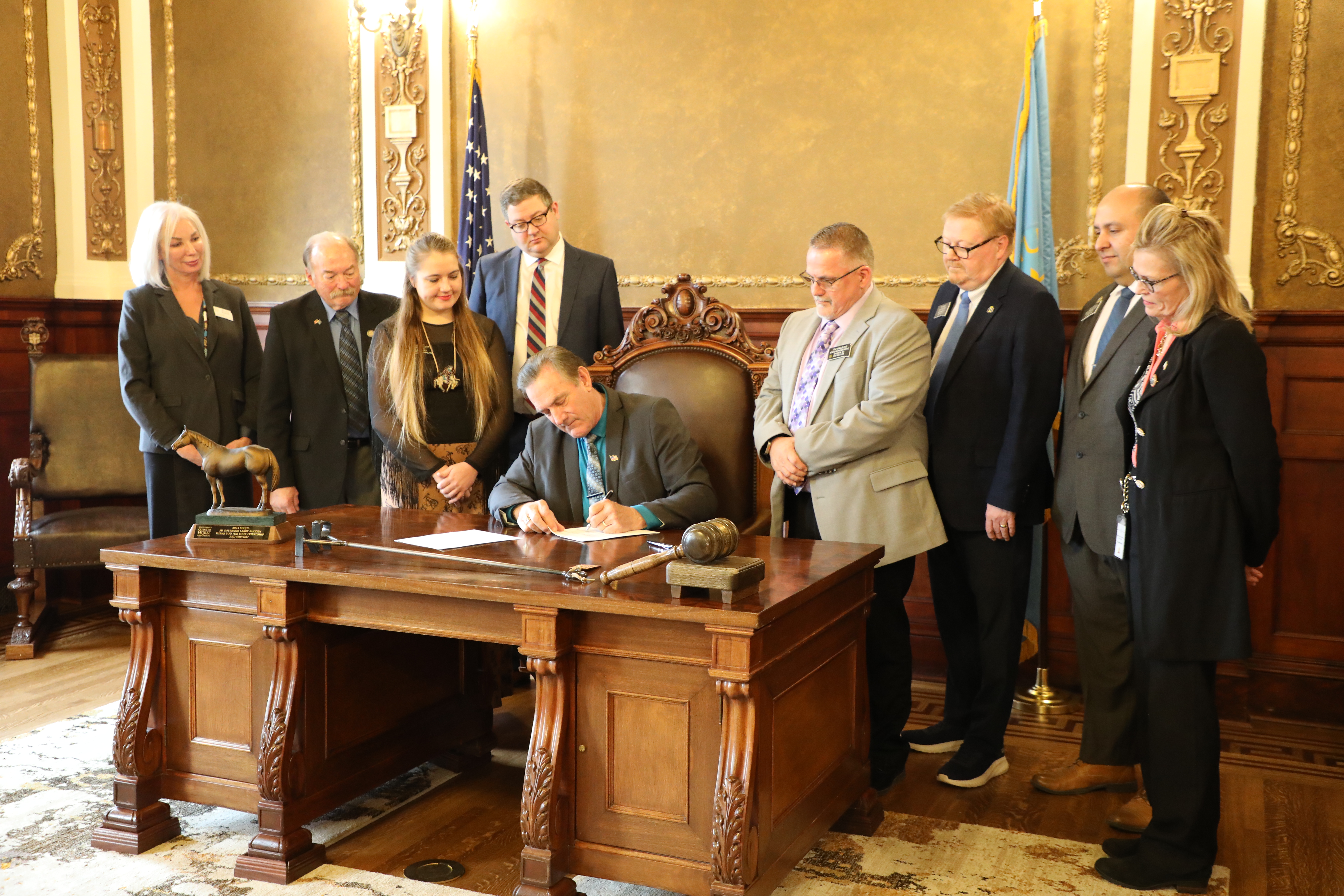 the state’s emergency medical systems. The bills establish protections for nurses and ambulance crews to help them operate as efficiently as possible.
“Keeping South Dakotans safe is my number one priority, and EMS teams are on the front lines those efforts,” said Governor Rhoden. “These bills give EMS professionals the protections and support they need to respond quickly and effectively – and they give South Dakotans peace of mind knowing help is always within reach.”
Genetic resistance to fatal disease: Oregon, Nevada, and Arizona are some of the only states in the West that have not registered a case of chronic wasting disease, a fatal illness that spreads through elk, deer, and moose. Now, researchers in Oregon are uncovering new evidence indicating that some elk in the state carry a genetic variation that’s resistant to the disease.
In a study of 183 animals, 42% of Oregon’s coastal Roosevelt elk and 49% of the Rocky Mountain elk carried the genetic marker.
Experts say that genetic resistance will give wildlife managers more time to prepare and combat the disease if it does make its way into Oregon.
Medal count: we’re a week into the 2026 Milan-Cortina Winter Olympics, and western athletes are already taking home hardware for the US. Wyoming native Breezy Johnson took home the first medal for Team USA when she secured gold in downhill skiing. She was followed closely by Elizabeth Lemley from Vail, Colorado, who won gold in freestyle moguls, and Jaelin Kauf from Wyoming, who took silver in the same event.
Other western medalists so far include Utahn Alex Hall’s silver medal in slopestyle skiing, Californians Alysa Liu and Madison Chock’s gold in figure skating, Chloe Kim’s silver in halfpipe, and others. The US medal count currently sits at 14.